Discover the temple with the largest system of stone walls engraved with the character 'Vạn' in Asia
With nearly 3,000 "Vạn" characters carved on stone, Cang Xa Temple in Tan Hung ward, Hai Phong city, has set a record as the temple with the largest system of stone walls inscribed with "Vạn" characters in Asia.
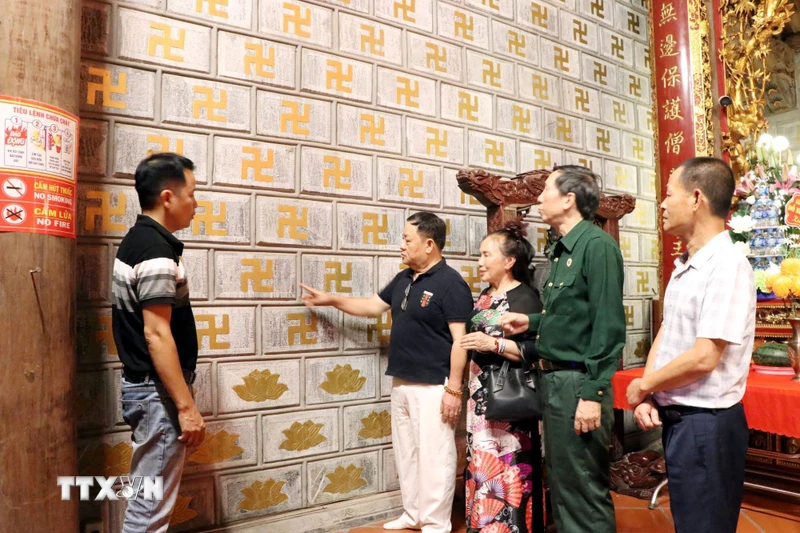
Cương Xa Temple (also called Quynh Khau Temple, meaning "Jade Hill") located in Tan Hung ward, Hai Phong city, is the temple with the most stone walls inscribed with the character "Vạn" recognized by the Asia Records Organization.
Sacred ancient temple
Cương Xá Temple is located on a high land in the southwest of Cương Xá village, now known as Cương Xá residential area, Tân Hưng ward, Hải Phòng city - an ancient land with the history of residence of 8 family lines.
According to the inscription, the temple was renovated for the first time during the reign of King Lê Vĩnh Tộ (Lê Thần Tông) in 1627, marking its historical depth over hundreds of years.
Through the wars, the temple had severely deteriorated. In 1946, the temple was renovated for the second time and there were no monks to reside there. In 1996, Ven. Thich Thanh Cuong was assigned to reside at Cang Xa Temple.
At that time, the temple had only three front halls and two small rear halls, which were dilapidated. However, the temple still preserved nine valuable wooden Bodhi Buddha statues, a large bell from the Le dynasty era, inscribed steles, statues, two ancient couplets, and an ancient large tree with a history of hundreds of years...
Venerable Thich Thanh Cuong, the abbot of Cuong Xa Temple, said that with the mindset of restoring the temple, in 2009, the temple requested permission from the former Hai Duong province authorities to renovate and restore the temple on the original site.
During the process of excavation for restoration and expansion, the temple's ancient remains and foundation were discovered, including brick remnants dating back to the Eastern Han Dynasty, approximately 2,000 years ago. These remains confirm that Cangsha Temple is an ancient temple with a very long history.
After restoration and renovation, the Cương Xá Temple complex has a total area of 7,385 m². The temple was built in the shape of the character "Công" (inner court, outer country - traditional architectural layout, characteristic of ancient temples in Northern Vietnam). To the right of the temple are the ancestral halls, while to the left are the halls dedicated to the Mother Goddess and the Holy General Trần, along with a clear well serving the daily life of the local people.
In addition, the temple has 18 massive lim wood pillars (8.2 meters high, each weighing about 1.7 tons) and many valuable statues, notably the white marble statue of Buddha Shakyamuni and the system of wooden Bodhi Tree statues.
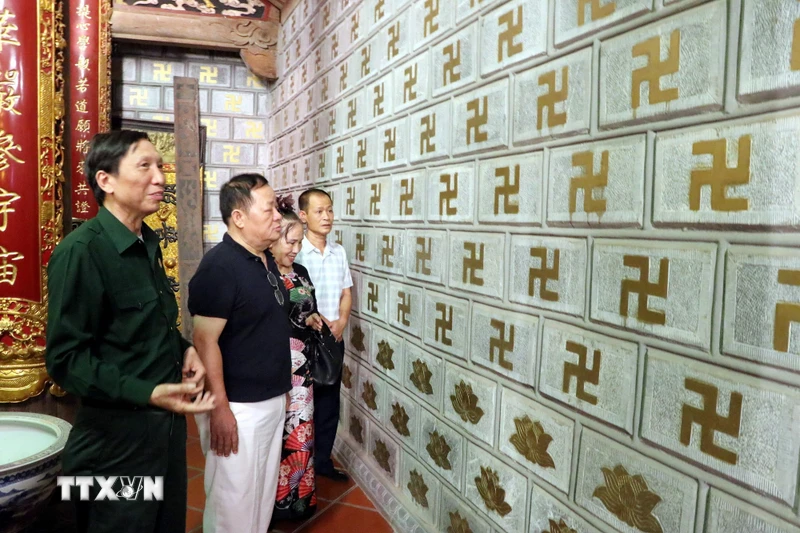
The temple has nearly 3,000 "Vạn" characters carved on stone.
The temple wall system is constructed using blue stone mined from Nhoi Mountain, Thanh Hoa province. Each row of the wall consists of 108 stones. Each stone has a length of 40cm, a width of 30cm, and a thickness of 35cm, with a weight of approximately 80kg.
In particular, the three lower rows of stones beneath the temple are finely carved with lotus patterns; from the fourth row upwards to the top, each stone is engraved with the character "Vạn" (meaning "ten thousand"), gilded with gold leaf in a solemn manner.
In total, the temple has nearly 3,000 "Vạn" characters carved into stone. This work not only demonstrates its scale but also represents a harmonious combination of architectural value, artistic carving, and Buddhist symbolism.
According to Senior Monk Thich Thanh Cuong, initially, the temple was designed to be built with wood. However, after a visit to Angkor Wat Temple (in the Kingdom of Cambodia), he saw the magnificent structure made of large stones, and the abbot decided to build the temple using smaller stones inscribed with the character "Vạn" (meaning "ten thousand").
Venerable Thich Thanh Cuong said that the three rows of stones below, the temple has used the image of a lotus flower, because the lotus is the national flower of Vietnam and Buddhism also takes the lotus as a symbol. From the fourth row, the stones are engraved with the word "Vạn." In Buddhist beliefs, the character "Vạn" is a symbol of auspicious clouds. The character "Vạn" is also one of the 32 excellent characteristics and one of the 80 beautiful features of the Buddha.
After nearly 7 years of restoration and craftsmanship, the new structure is completed. The "Vạn" character system is finely carved on the stone wall system surrounding the temple area, creating a unique architectural imprint, with strong aesthetic value and Buddhist symbolic meaning.
Previously, in August 2015, Cương Xá Temple was awarded the certificate of establishing a record as the first temple in Vietnam with a stone wall system engraved with the character "Vạn" (meaning "ten thousand") by the Vietnam Records Organization (VietKings).
Venerable Thich Thanh Cuong shared that despite the many changes in the times, the Buddhist lineage here has never been interrupted, and the sound of the temple bell still echoes through generations. The temple still preserves many valuable cultural relics from the Later Le period, while also acknowledging the merits of the predecessors, local people, and Buddhist followers in jointly preserving, protecting, and promoting the spiritual cultural traditions of their hometown.
From a temple that still faces many difficulties, after many years of construction and renovation, many projects have now been completed in a grand and tidy manner, contributing to meeting the religious activities and practice needs of Buddhist followers.
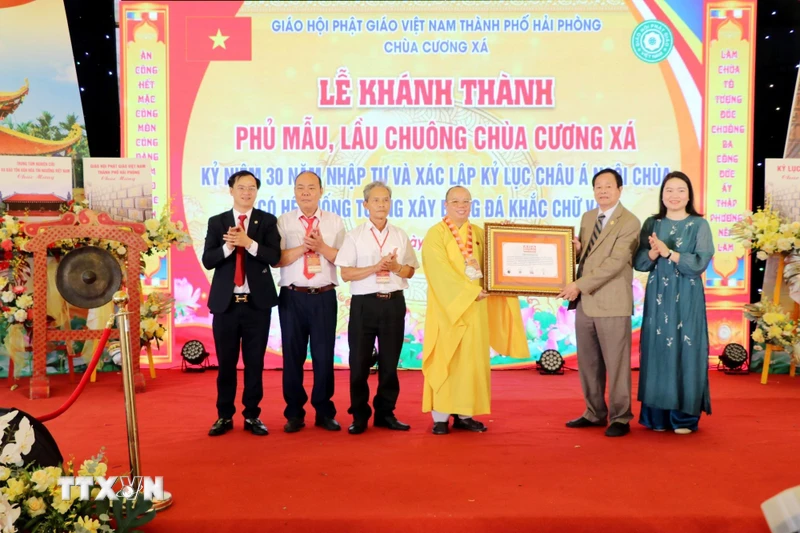
Recently, on May 3rd, Cương Xá Temple held the inauguration ceremony of the Mẫu Pavilion and the Bell Tower. Ven. Thích Thanh Cường emphasized that the completion of the Mẫu Pavilion carries the significance of honoring filial piety and preserving the traditional cultural and religious values. Meanwhile, the Bell Tower is a symbol of the ringing bell, spreading the spirit of compassion and goodness in community life.
Cương Xá Temple gathers historical values preserved through generations, while also featuring distinctive architectural characteristics with a system of stone walls engraved with the word "Vạn" (ten thousand). Not only is it an outstanding religious structure, but the temple also embodies the harmonious integration of Vietnamese culture, art, and Buddhist faith.
The project contributes to enriching the local heritage identity, while affirming its unique value within the overall Vietnamese temple architecture.
Read the original article atthis.

Post a Comment for "Discover the temple with the largest system of stone walls engraved with the character 'Vạn' in Asia"
Post a Comment